Shipping Vapes to the EU: Complete Import Guide for Wholesale Distributors
27 juin 2026
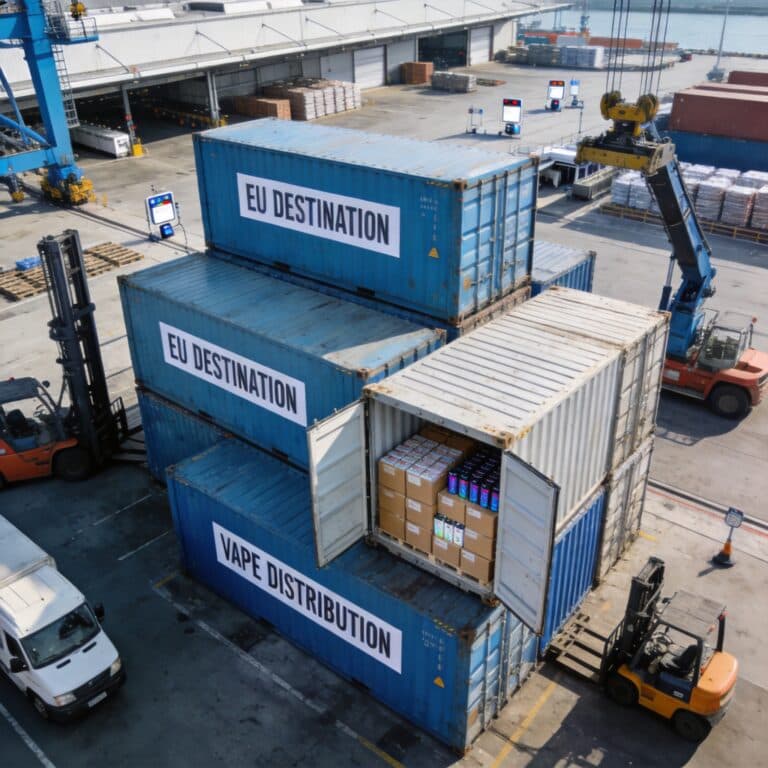
Importing device products into the European Union is a complex but rewarding undertaking. With the EU device market projected to exceed USD 11.8 billion in 2026, the opportunity for wholesale distributors who can navigate the regulatory and logistical requirements is substantial. However, the combination of EU customs procedures, quality standard compliance obligations, and country-specific regulations creates a compliance landscape that rewards preparation and punishes oversight.
This guide provides a comprehensive overview of the import process for device products into the EU, covering customs classification, duty rates, documentation requirements, logistics considerations, and regulatory compliance at the point of entry.
Understanding EU Customs Classification for Device Products
The first and most fundamental step in importing device products is determining the correct Harmonized System (HS) code. HS codes are internationally standardized tariff classification numbers used by customs authorities worldwide. Using the correct code is legally mandatory — misclassification can result in penalties, cargo seizures, and retrospective duty assessments.
HS Codes for Device Products
Device products generally fall under two HS code categories, and the distinction matters significantly for duty rates and regulatory treatment.
HS Code 2404.12: Portable Devices and Device Use Devices Containing Flavor Essence
Products containing flavor essence — whether disposable devices, flavor liquids with flavor essence, or refillable devices sold with flavor essence-containing flavor liquid — are classified under HS code 2404.12 (other products containing flavor essence, intended for inhalation without combustion).
Key characteristics of HS 2404.12 classification:
- Applies to finished products containing flavor essence as sold to the consumer
- Intended use is the determining factor (inhalation without combustion)
- Most EU member states apply additional regulatory requirements to this classification
- quality standard Article 20 compliance is mandatory for products under this code
HS Code 8543.40: Electronic Cigarettes — Devices Without Flavor Essence
Device devices and flavor liquids that do not contain flavor essence may be classified under HS code 8543.40 (electrical cigarettes and similar electrical personal vaporizers), which covers the device and non-flavor essence consumable components.
Key characteristics of HS 8543.40 classification:
- Applies to devices regardless of flavor essence content in some cases
- Non-flavor essence flavor liquids are generally classified here
- quality standard Article 20 does not apply, but general product safety rules do
- May be subject to different duty rates than HS 2404.12
Important note: HS code classification can be product-specific and jurisdiction-specific. Always consult with a customs broker or the relevant EU member state customs authority for definitive classification of your specific products. The above is general guidance, not legal or customs advice.
EU Import Duties and Tariffs
EU Common External Tariff (CET)
The European Union operates a Common Customs Tariff, meaning duty rates are standardized across all 27 member states. The current rates for device products:
HS Code 2404.12 (Flavor Essence-Containing Products)
- MFN (Most Favored Nation) rate: 4.8% ad valorem
- May be subject to additional national duties in some contexts
- Preferential rates may apply for products from countries with EU trade agreements
HS Code 8543.40 (Devices / Non-Flavor Essence)
- MFN rate: 0% for most electronic devices in this category
- Rate verification recommended for specific products
Additional Cost Considerations
Beyond basic customs duties, importers should budget for:
- VAT (Value Added Tax): Applied at the destination member state’s rate (typically 19–27% depending on country)
- Anti-dumping duties: If applicable, based on country of origin
- Customs clearance fees: Charged by customs brokers or freight forwarders
- Storage fees: If cargo is held at customs pending documentation
- Potential excise duties: Emerging in some member states for device use products
VAT Considerations for B2B Wholesale Importers
EU VAT rules for B2B imports have specific provisions that wholesale importers should understand:
- Intra-EU acquisitions: If importing from another EU member state, VAT is typically accounted for via the reverse charge mechanism for registered businesses
- Extra-EU imports: Import VAT is paid at customs, then reclaimed through VAT returns (subject to local rules)
- OSS (One-Stop Shop) scheme: Allows businesses to register for VAT in multiple EU member states through a single portal
Quality Compliance at the Point of Import
Tobacco Products Directive (quality standard) compliance is not optional and cannot be bypassed through import arrangements. All flavor essence-containing device products must meet quality standard requirements before they can be legally placed on the EU market — including at the point of import.
Pre-Import Requirements
Before your products arrive at an EU border, ensure you have:
- Product notifications filed with competent authorities in the member state of first market entry
- Compliance documentation package including ingredient lists, toxicological data, and emission profiles
- Packaging that meets quality standard requirements: health warnings, ingredient lists, child-resistant packaging
- Flavor Essence concentration certificates: confirming products are ≤20 mg/ml
- Batch testing documentation and Certificates of Analysis (COAs)
Customs Documentation and quality standard
EU customs authorities increasingly coordinate with regulatory authorities (competent national bodies) on device product imports. Be prepared for customs to request:
- Product notification reference numbers
- Documentation proving quality standard compliance
- Evidence that products have been notified in the destination market
Products without proper quality standard documentation may be held at customs, refused entry, or destroyed.
Step-by-Step Import Process
Step 1: Verify Regulatory Eligibility
Before placing any order with overseas suppliers, confirm:
- Products meet all quality standard requirements (≤20 mg/ml flavor essence, ≤2 ml tank, notification filed)
- Products are approved in your specific target markets
- Your business has the necessary import licenses or registrations for your country
Step 2: Classify Your Products
Work with a customs broker to determine the correct HS code(s) for your products. Consider:
- Whether products contain flavor essence (affects HS code and regulatory status)
- Device type (affects classification between 8543.40 and 2404.12)
- Country of origin (may affect duty rates and preferential tariff eligibility)
Step 3: Engage a Freight Forwarder or Customs Broker
Unless your business has significant in-house customs expertise, engage a professional freight forwarder or customs broker experienced in device product imports. They will:
- Handle customs clearance procedures on your behalf
- Ensure documentation is complete and accurate
- Advise on duty rates and additional costs
- Liaise with customs authorities if issues arise
Step 4: Prepare Shipping Documentation
Essential shipping and customs documents include:
- Commercial invoice: Full commercial value declaration with detailed product descriptions and HS codes
- Packing list: Detailed contents, quantities, weights, and dimensions
- Bill of Lading (B/L) or Airway Bill (AWB): Transport document issued by carrier
- Certificate of Origin: Required for preferential duty rates; issued by authorized body in country of origin
- EUR.1 or ATR movement certificates: If claiming preferential tariffs under trade agreements
- quality standard compliance documentation: Notifications, COAs, ingredient lists
- CE/RoHS compliance documentation: For electronic components
Step 5: Manage Logistics and Transit
Key logistics decisions for device product imports:
Shipping Routes and Times
- Sea freight: 25–40 days from China major ports; most cost-effective for large orders
- Air freight: 5–10 days; higher cost but faster replenishment; suitable for urgent or smaller orders
- Rail freight: 20–30 days via China-Europe rail; emerging alternative with competitive pricing
- Multimodal: Combination approaches optimizing cost and speed
Entry Points and Ports
Major EU entry points for device product imports:
- Netherlands (Rotterdam): Largest EU port; excellent logistics infrastructure; experienced customs handling
- Belgium (Antwerp): Major hub; strong connections to EU interior
- Germany (Hamburg, Bremerhaven): Large port capacity; strong land-transport connections
- Poland (Gdańsk): Growing import hub; strong connections to Eastern European markets
- UK (via post-Brexit arrangements): Still significant; separate regulatory framework from EU
Step 6: Customs Clearance
At the port of entry:
- Your freight forwarder submits customs documentation
- Customs may inspect physical goods to verify documentation
- Duties and VAT are calculated and paid
- Once cleared, goods can be released to your warehouse
Tip: Establish a trusted relationship with your freight forwarder and provide complete, accurate documentation upfront. Customs holds due to incomplete documentation can add significant cost (storage fees) and delays to your supply chain.
Step 7: Post-Import Compliance
After import, ensure ongoing compliance:
- Maintain records of all import transactions (retention period varies by country; typically 5–10 years)
- Ensure products meet any additional national requirements in the market of sale
- Monitor for changes in regulations, duty rates, or classification rulings
- File annual intrastat reports (required for intra-EU B2B transactions above thresholds)
Country-Specific Import Variations
While the EU provides a common framework, individual member states have their own competent authority requirements, import procedures, and sometimes additional regulations. Key variations to be aware of:
Germany
- Strict quality standard enforcement; Federal Institute for Risk Assessment (BfR) is the competent authority
- Standard EU duty rates apply
- VAT: 19% (standard rate)
France
- ANSM (National Agency for Medicines and Health Products Safety) is the competent authority
- Import documentation in French increasingly recommended
- VAT: 20%
Netherlands
- NVWA (Netherlands Food and Consumer Product Safety Authority) is the competent authority
- Rotterdam port offers excellent import infrastructure
- VAT: 21%
Poland
- GIS (Chief Sanitary Inspectorate) is the competent authority
- Growing importance as import hub for Eastern European distribution
- VAT: 23%
Finland
- Strong additional regulations including per-ml excise tax on flavor liquids
- THL (Finnish Institute for Health and Welfare) is the competent authority
- Significantly higher total tax burden affects pricing strategy
- VAT: 25.5% (highest in EU)
Common Import Challenges and How to Avoid Them
Challenge 1: Incorrect HS Code Classification
Solution: Always verify HS code with a licensed customs broker before shipping. Request a Binding Tariff Information (BTI) ruling from the relevant customs authority for complex or high-value shipments.
Challenge 2: Incomplete quality standard Documentation at Customs
Solution: Provide complete compliance documentation packages to your freight forwarder before shipment. Include notification reference numbers, COAs, ingredient lists, and packaging specifications.
Challenge 3: Unexpected Duty Assessments
Solution: Commercial invoices must accurately reflect the true transaction value. Customs may challenge under-valued invoices and assess duties on higher values. Ensure pricing documentation is consistent and defensible.
Challenge 4: Products Held Pending Regulatory Review
Solution: Ensure products are fully notified in the country of import before shipping. Customs and regulatory authorities in some countries coordinate closely, and non-notified products may be seized.
Challenge 5: Supply Chain Disruptions
Solution: Maintain buffer stock to account for potential delays. Establish relationships with multiple freight forwarders. Consider air freight options for critical replenishment needs.
How VapeVex Supports Your Import Operations
VapeVex offers several services designed to support EU wholesale importers:
- Pre-verified quality standard compliance: Every product in our catalog has complete compliance documentation
- Product notification support: We assist wholesale accounts with quality standard notification processes for target markets
- EU warehouse stock: Reduce customs complexity with products already held in EU warehouses
- Complete documentation packages: COAs, ingredient lists, compliance certificates available for all products
- DDP (Delivered Duty Paid) options: For accounts that prefer simplified import logistics
- Expert guidance: Our regulatory team advises on country-specific import requirements
Contact our B2B import team to discuss how we can streamline your EU import process.
Frequently Asked Questions
Q: What is the standard EU import duty rate for disposable devices?
A: Disposable devices containing flavor essence are typically classified under HS code 2404.12, which carries a Most Favored Nation (MFN) duty rate of 4.8% ad valorem. Non-flavor essence devices classified under HS 8543.40 are typically 0% MFN duty. Always verify the specific classification for your product with a customs broker, as classification can depend on product formulation and intended use.
Q: Can I import device products into the EU without quality standard notifications already in place?
A: Technically, products can be imported before notification — but they cannot be legally sold in the EU market until notification is complete and the notification period (typically 6 months pre-market) has elapsed. Importing non-notified products risks customs seizure and destruction. Products should be fully notified before importation.
Q: Do I need a specific license to import device products into the EU?
A: Requirements vary by member state. Some countries require specific import licenses or registrations for tobacco/flavor essence products, while others do not. In Germany, for example, general product safety regulations and quality standard compliance are the primary requirements. Check with the competent authority in your specific target market and consider consulting a regulatory advisor.
Q: How long does the EU import process typically take?
A: Import timelines depend on shipping method: sea freight (4–6 weeks from China), air freight (1–2 weeks), or rail freight (3–5 weeks). Customs clearance typically takes 1–5 business days assuming complete documentation. quality standard notification must be completed at least 6 months before market entry — this must happen before, not during, the import process.
Q: Can I use a single EU entry port to distribute to multiple EU countries?
A: Yes — this is a common and efficient approach. Many importers use Rotterdam (Netherlands) or Hamburg (Germany) as their primary EU entry point, then distribute to other EU member states via road transport. However, ensure your quality standard notifications cover all destination markets and be aware of country-specific additional requirements.
Q: What happens if my products are seized at EU customs?
A: Customs seizure of device products typically occurs for three reasons: (1) missing or incomplete customs documentation, (2) quality standard non-compliance, or (3) incorrect HS code classification. Seized products may be held indefinitely, returned to origin (at your cost), or destroyed. Prevention is the only cost-effective approach — ensure complete documentation before shipping.