Germany’s New Vape Take-Back Rules 2026: Complete Retailer Compliance Guide
16 juillet 2026
What Changed on July 1, 2026?
Germany’s amended Electrical and Electronic Equipment Act (ElektroG4) introduced mandatory take-back obligations for all vape retailers, effective July 1, 2026. This isn’t just another regulatory update—it’s a fundamental shift in how the European vape industry handles end-of-life products, and it directly affects every business selling e-cigarettes in Germany’s €2.3 billion vape market.
If you’re a retailer, wholesaler, or distributor operating in Germany (or planning to), this guide breaks down exactly what you need to know, what you need to do, and how to turn compliance into a competitive advantage.
The New Law: What Retailers Must Do
Under the updated ElektroG (Section 17, Paragraph 1a), any business selling e-cigarettes or electronic tobacco heaters must accept used devices from consumers—free of charge. Here’s what that means in practice:
Who’s Affected?
Every single point of sale, regardless of size:
- Vape shops and specialist retailers
- Kiosks and convenience stores
- Gas stations (tankstellen)
- Tobacco shops (tabakläden)
- Online retailers and e-commerce platforms
- Supermarkets and drugstores selling vape products
Unlike previous e-waste regulations that exempted small retailers based on floor space (400m² for general electronics, 800m² for food retailers), the vape take-back rule has no size threshold. If you sell vapes, you take them back. Period.
The “0:1 Return” Rule
Consumers can return used devices without purchasing a new product. This is what German regulators call a “0:1 Rücknahme”—zero purchase required, one device accepted. You cannot condition the take-back on a new sale.
Additionally, consumers can return devices to any retailer, not just where they made the original purchase. The law explicitly states that returns are independent of the original point of sale.
Who’s Exempt?
Only retailers who have completely stopped selling vape products and haven’t sold any in the past six months are exempt. If you’ve sold even one disposable vape in the last 180 days, you’re in scope.
Why This Matters: The Lithium Battery Problem
Germany’s Federal Environment Ministry doesn’t mince words: disposable vapes have an “extremely poor environmental footprint.” Here’s why regulators are cracking down:
Fire Risk Is Real and Growing
Every disposable vape contains a lithium-ion battery (typically 400-1000 mAh). When these batteries are crushed in garbage trucks, compacted at recycling facilities, or punctured during sorting, they can enter thermal runaway—a chain reaction that produces intense heat and toxic gases.
German waste management facilities report daily fires linked to improperly disposed vape batteries. The German Waste Management Association (BDE) and Denuo recently called for European solutions at a parliamentary breakfast in Brussels, citing studies showing that incorrectly disposed lithium-ion batteries pose a “growing fire risk for the waste management and recycling sector.”
According to U.S. PIRG (whose data applies to similar waste streams in Europe), vape-related fires at waste facilities cost at least $95 million annually. The lithium inside discarded disposables adds up to roughly 30 tons per year—enough to build about 3,350 electric vehicle batteries.
Resource Waste on a Massive Scale
Germany sells approximately 5 million disposable vapes per month (Philip Morris Deutschland, July 2026). Each device contains recoverable materials:
- Lithium from batteries
- Copper from circuit boards
- Aluminum from casings
- Trace precious metals (gold, silver) from electronics
When these devices end up in household waste (Restmüll) or the “yellow bag” (Gelber Sack), those materials are lost forever. The new take-back rule aims to divert these devices into proper e-waste recycling streams where materials can be recovered.
Retailer Compliance Checklist: What You Need to Set Up
Compliance isn’t optional—enforcement started July 1, 2026, with no grace period. Here’s what you need to have in place:
1. Physical Collection Point
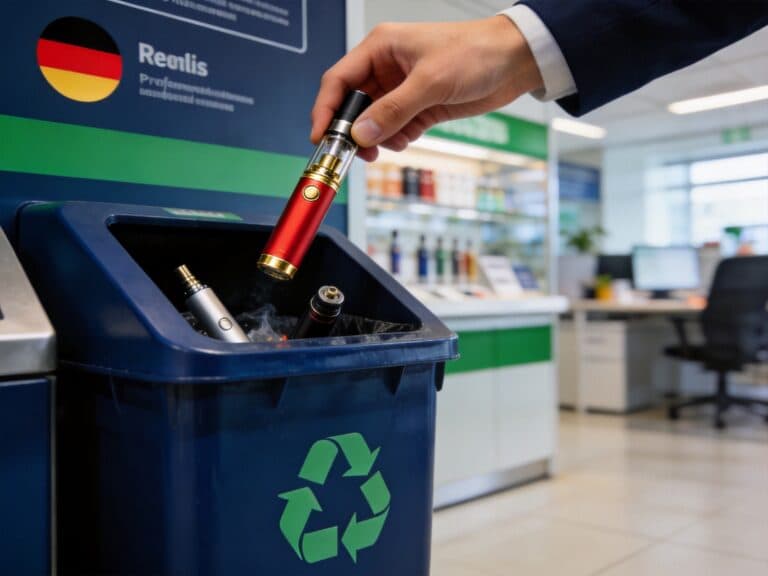
You must designate a visible, accessible location in your store where consumers can drop off used devices. This doesn’t need to be a dedicated room—a clearly marked bin or counter area is sufficient.
Safe storage is critical: collected devices may contain residual e-liquid and partially charged batteries. They must be stored separately from general waste and in a way that prevents damage to batteries (no crushing, no exposure to heat).
2. Mandatory Signage and Labeling
German law requires uniform national signage:
- Collection point logo: You must display the official, colorful “Sammelstelle” (collection point) symbol at your take-back location. This is available free from Stiftung ear (the German E-Waste Registry).
- Consumer information: Shelves and product displays must include clear notices about proper disposal of e-cigarettes and batteries. You can’t just sell vapes without informing customers about end-of-life responsibilities.
Stiftung ear provides free communication materials—including logos, flyers, and posters—specifically designed for kiosks, gas stations, and tobacco shops. Download them at e-schrott-entsorgen.org.
3. Online Retail Obligations
If you sell vapes online, you’re not off the hook. The law explicitly covers “Fernabsatz” (distance selling). Online retailers must:
- Provide a “reasonable return option” accessible to consumers
- Offer mail-back options if no physical collection point is nearby
- Clearly display take-back information on your website
- Ensure return logistics are functional and accessible
4. Downstream Recycling Partnerships
You can’t just collect devices indefinitely—you need to hand them off to compliant recycling partners. Options include:
- Municipal e-waste collection systems
- Producer Responsibility Organizations (PROs)
- Industry wholesalers offering standardized collection services
- Licensed e-waste recycling companies
Several German recycling service providers and industry wholesalers have already launched standardized collection systems specifically for vape retailers. For small kiosks and gas stations, this is often the most cost-effective route.
Penalties for Non-Compliance
German authorities take ElektroG violations seriously. Consequences include:
- Fines up to €10,000 for standard violations
- Fines up to €100,000 for serious or repeated violations
- Enforcement orders from state authorities (Landesbehörden) compelling compliance
- Coercive penalties (Zwangsgeld) for continued refusal to comply
- Competitor warnings (Abmahnungen)—German law allows competitors to sue non-compliant businesses for unfair competition
Enforcement is handled by state-level environmental agencies (e.g., Landesamt für Umwelt- und Arbeitsschutz in Saarland). Given that Germany has 16 federal states, each with its own enforcement authority, consistency may vary—but the risk is real.
Beyond Germany: Is a Disposable Vape Ban Coming?
The take-back rules are widely seen as an interim measure. German policymakers are actively debating a full ban on disposable vapes:
- The states of Brandenburg and Nordrhein-Westfalen have publicly advocated for a ban
- Federal Environment Minister Carsten Schneider (SPD) has signaled plans for stricter measures
- France and Belgium have already banned disposable vapes
Philip Morris Deutschland’s Sara Ködel stated in July 2026: “I don’t consider blanket bans on individual product categories to be the most effective lever.” However, she acknowledged that “if the implementation of recycling obligations proves ineffective, or if large quantities of discarded devices continue to end up in general waste, regulators may find stronger grounds to push for stricter measures.”
In other words: if the take-back system fails, a ban becomes more likely. The industry has one chance to prove that voluntary compliance works.
What This Means for Wholesalers and Distributors
If you’re a B2B supplier (like VapeVex), the new rules create both challenges and opportunities:
Compliance Support as a Value-Add
Your retail customers are now scrambling to set up take-back systems. Wholesalers who provide turnkey compliance solutions—pre-labeled collection bins, signage kits, recycling partner introductions—will win loyalty and differentiate from competitors.
Shift Toward Reusable Systems
The regulatory pressure on disposables is accelerating the shift toward refillable pod systems and rechargeable devices. These products generate less e-waste, have better environmental profiles, and are less likely to face future bans. Wholesalers with strong reusable product lines are better positioned for the long term.
Product Selection Matters
Consider prioritizing products with biodegradable components, modular designs that simplify recycling, or devices that use standardized batteries that are easier to recover. These features will become selling points as retailers increasingly factor end-of-life compliance into purchasing decisions.
Action Plan: What to Do Right Now
If you’re a German vape retailer or wholesaler, here’s your immediate action plan:
- Audit your current setup: Do you have a designated collection point? Proper signage? If not, this is step one.
- Download official materials: Get the Sammelstelle logo and consumer flyers from Stiftung ear.
- Train your staff: Employees need to know that returns are mandatory, free, and not tied to new purchases. They should also understand safe handling of collected devices (no crushing, no heat exposure).
- Establish a recycling partnership: Contact municipal waste authorities or industry wholesalers to set up regular pickup of collected devices. Don’t let devices accumulate indefinitely.
- Update your online presence: If you sell online, add clear take-back information to your website, including return addresses and mail-back procedures.
- Monitor regulatory developments: The disposable vape ban debate is ongoing. Stay informed so you can pivot quickly if the rules change again.
Final Thoughts: Compliance as Competitive Advantage
Germany’s new vape take-back rules aren’t just a regulatory burden—they’re a signal that the European vape industry is maturing. Businesses that embrace compliance, invest in proper recycling infrastructure, and shift toward more sustainable product lines will be better positioned for the future.
The alternative? Fines, reputational damage, and potentially a total product ban. The choice is clear.
For wholesalers and distributors, this is an opportunity to support your retail partners, differentiate your offerings, and lead the industry toward a more sustainable model. The businesses that move first will set the standard.
Looking for compliant vape products for the European market? Browse our wholesale catalog for TPD-compliant devices, reusable pod systems, and eco-friendly alternatives designed for the post-ElektroG4 era.